



The hour before the real interview starts
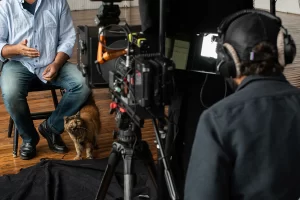
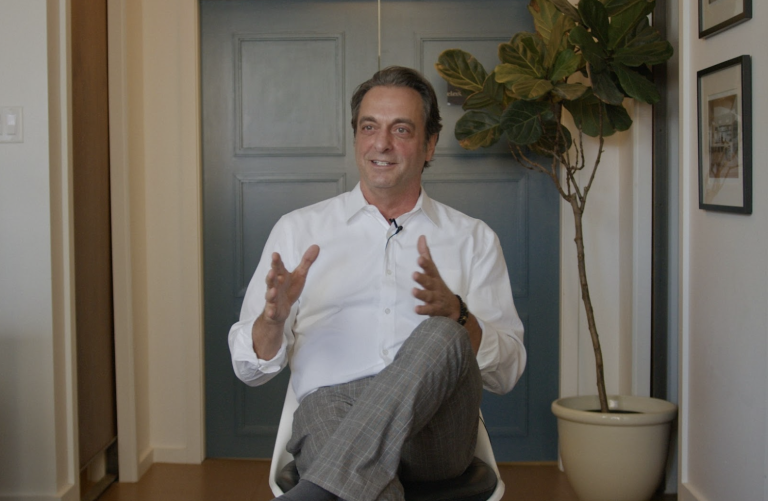
I’ve sat across from a lot of founders with a camera rolling. There’s a pattern I can almost set a clock by. For the first 10 minutes, you get the version of the story they’ve told at conferences and in pitch meetings and to their in-laws at Thanksgiving. It’s polished. It’s true, mostly. And it’s completely forgettable.
Then our director asks a question that wasn’t on the list. Something like, “What did that year cost you?” Or, “Who told you it wouldn’t work, and were they a little bit right?” And the founder goes quiet. They look at the floor for a second. And when they look back up, the interview starts over, except now it’s real.
Drawing out authenticity is our main job . Not the lighting, not the lenses… okay the edit is also very important. But thethe questions,are what build the ingredients. After twenty years of making documentaries, I’ve come to believe that almost everything worthwhile I’ve been part of, in film and in business, traced back to someone asking a better question than the one everybody else was asking.
Questions are the founder’s actual superpower
Founders like to think our edge is vision, or grit, or some instinct for the market. Maybe. But look closely at the moments where a company actually changed course and you’ll usually find a question underneath it. Not a brilliant answer. A question that made the old answer impossible to keep believing.
It starts with the ones you ask yourself. “Why am I still doing this?” is a terrifying question at $10M, because the honest answer is often “because nobody else can,” and that’s not a business, that’s a job with a very expensive office. The better question is “What would have to be true for this company to run without me in the room?” Ask that one and you stop building a bigger version of yourself and start building something that can outlast your attention span.
It’s the same with the people you lead. The worst coaching I’ve ever done was when I knew the answer and tried to hand it over. The best was when I shut up and asked, “What do you think is actually going on here?” and then waited through the silence. People will defend a conclusion you gave them for about a week. They’ll defend one they reached themselves for years.
And it’s true of strategy. Most strategy meetings are answer-generating machines. Somebody presents a plan, everybody reacts to the plan, the plan gets slightly better. The rooms that change companies are the ones where someone asks the question nobody wants on the whiteboard. “If we’re so good, why are we still competing on price?” “What are we pretending not to know about our best customer?” “If a competitor wanted to beat us in three years, what would they do that we’re refusing to do?”
A great question has a particular texture. It’s specific. It’s a little uncomfortable. And it can’t be answered with the thing you were already planning to say.
Without conflict, there is no story
Here’s why the right question matters so much on a film set. A question that’s working is a question that’s hunting for conflict. Not drama for its own sake. Conflict in the storytelling sense: a person who wanted something, and something that stood in the way, and what it took to get through.
That’s not a stylistic preference. It’s the definition. Every story you’ve ever cared about, from the ones your grandfather told to the ones you paid fifteen dollars to sit through, has conflict at the center. Take it out and you don’t have a gentler story. You have no story at all. You have a brochure.
And a brochure is exactly what most companies end up with, even when they started out wanting something better. I’ve watched the arc a hundred times. We sit down for story development and the room comes alive. The founder starts talking about the lesson they actually learned, the year they nearly didn’t make payroll, the first product that was wrong and how long it took them to admit it. Everyone around the table can feel it. That’s the film. That’s the one people will remember.
Then a week goes by and the fear sets in. Someone wonders what a customer might think. Someone else wonders what the board might think. A VP asks whether we really need the part about the payroll. And by the time the notes come back, the near-miss has become “we navigated a challenging period,” and the wrong product has become “we listened to our customers.” Every true thing that lit up the room has been sanded down until it’s smooth enough to say nothing.
The instinct is understandable. Conflict feels like exposure. But think about what that sanitized version actually communicates to a smart buyer, or a smart recruit. It tells them you have something to hide, or that you don’t trust them with the truth, or that you’re exactly like everyone else. None of those is the message you paid for.
The companies that get this right do the opposite. They lead with the hard part. The founder who says, on camera, “I was wrong about this for three years” is more trustworthy in that one sentence than the founder who spends twenty minutes being impressive. Because we all know what it costs to say that. The willingness to pay it is the proof.
Trust is the only thing you’re actually selling
I used to think we were in the video business. We’re not. We’re in the belief business. A real story builds belief, and belief is what turns into revenue. Everything else is production.
Strip away the vocabulary and a founder-led company runs on trust in four directions at once. Prospects have to trust you enough to pick up the phone, and then enough to sign. Partners have to trust that you’ll still be who you said you were when the deal gets hard. Recruits have to trust that the culture you describe in the interview is the one they’ll show up to on a Tuesday in February. And your own people have to trust that the version of you they see in the all-hands is the same one in the room when things go wrong.
What’s interesting is that the same raw material builds all four. The honest story about the year you nearly lost it is the thing that makes a buyer lean in, and it’s also the thing that makes a great engineer decide you’re worth betting a career on, and it’s also the thing that makes your current team feel like they’re part of something true rather than something performed.
That’s why I keep coming back to the word moat. A product can be copied. A pricing model can be copied. A well-designed website can be copied by Friday. But nobody can copy your story, because nobody else lived it. When a company’s real story is told well and distributed widely, it becomes the one asset a competitor literally cannot build. They can’t fake your conflict. They weren’t there.
So the question to ask about every piece of content your company puts out isn’t “does this make us look good?” It’s “does this make someone trust us more than they did before they watched it?” Those two questions have very different answers, and only one of them shows up in the pipeline.
From $10M to nine figures: become a media company, but not the kind you think
There’s a specific stretch in a founder-led company’s life where all of this stops being philosophy and starts being the growth plan. Somewhere between $10M and $100M. The founder is still the reason customers buy and the reason good people join. That’s the superpower. It’s also the ceiling, because one person can only be in so many rooms.
The way through isn’t to make the founder less central. It’s to make the founder’s story travel without the founder. That’s what it means to become a media-first company. Not a company with a marketing department that makes videos, but a company that treats its own story as core infrastructure, the same way it treats its product or its sales process.
Most people hear “media-first” and think volume. Post every day. Be everywhere. Clip everything. I’d push back hard on that. Being prolific is easy now; a machine can be prolific. Being prolific with sanitized, conflict-free content just means you’re forgettable at scale. The founders I’ve seen break through did something harder and simpler. They figured out which three or four stories actually carried the weight of the company, told those with real craft, and then got relentless about distribution.
And distribution means two directions. Everyone thinks about the outside: prospects, partners, the market. Fewer think about the inside, and the inside might matter more. A company at $40M with four hundred people has hundreds of employees who have never met the founder and never heard the origin story from the person who lived it. If the real story only lives in a sales deck, you’ve built a brand your own team doesn’t believe in. The same documentary that closes a deal should be the first thing a new hire watches, the thing managers reference when the culture drifts, the thing that lets a leader in another city say “this is why we do it this way” and mean it.
Here’s the practical shape of it. A few flagship films that tell the real story, conflict intact, will do a lot of work. But a docu-series does more, and I’d argue it does something a one-off film can’t. A single film is a moment; a series is a relationship. It gives the story room to unfold over time, lets the audience watch a company actually deal with something rather than summarize it afterward, and gives you a reason to show up in someone’s feed again next month that isn’t “we have an announcement.” Around that, a steady rhythm of smaller pieces, customer stories, behind-the-scenes, the founder thinking out loud, keeps it alive between episodes. A distribution plan that treats internal audiences as seriously as external ones. And a willingness to let the founder be a person on camera, not a spokesperson, because the whole point is that nobody can copy a person.
That’s a different kind of media company. It’s one that has the storytelling power of an in-house studio without turning the founder into a full-time content creator. The story does the traveling. The founder gets to go build.
The question worth asking
I’ll end where I started, with that moment in the interview when the founder looks at the floor. What’s happening in that silence is that they’re deciding whether to trust us with the real thing. Every time they do, the film gets better, and so does the company, because the story they finally tell on camera is usually the one they needed to hear themselves say out loud.
So here’s the question I’d leave with you, whether you’re thinking about your next film or your next five years. What’s the part of your story you’ve been leaving out because it’s not flattering? Not the part that’s embarrassing in a petty way. The part that cost you something.
That’s your story. The rest is a brochure. And nobody has ever built a nine-figure company, or a loyal team, or a brand people love, on a brochure.
